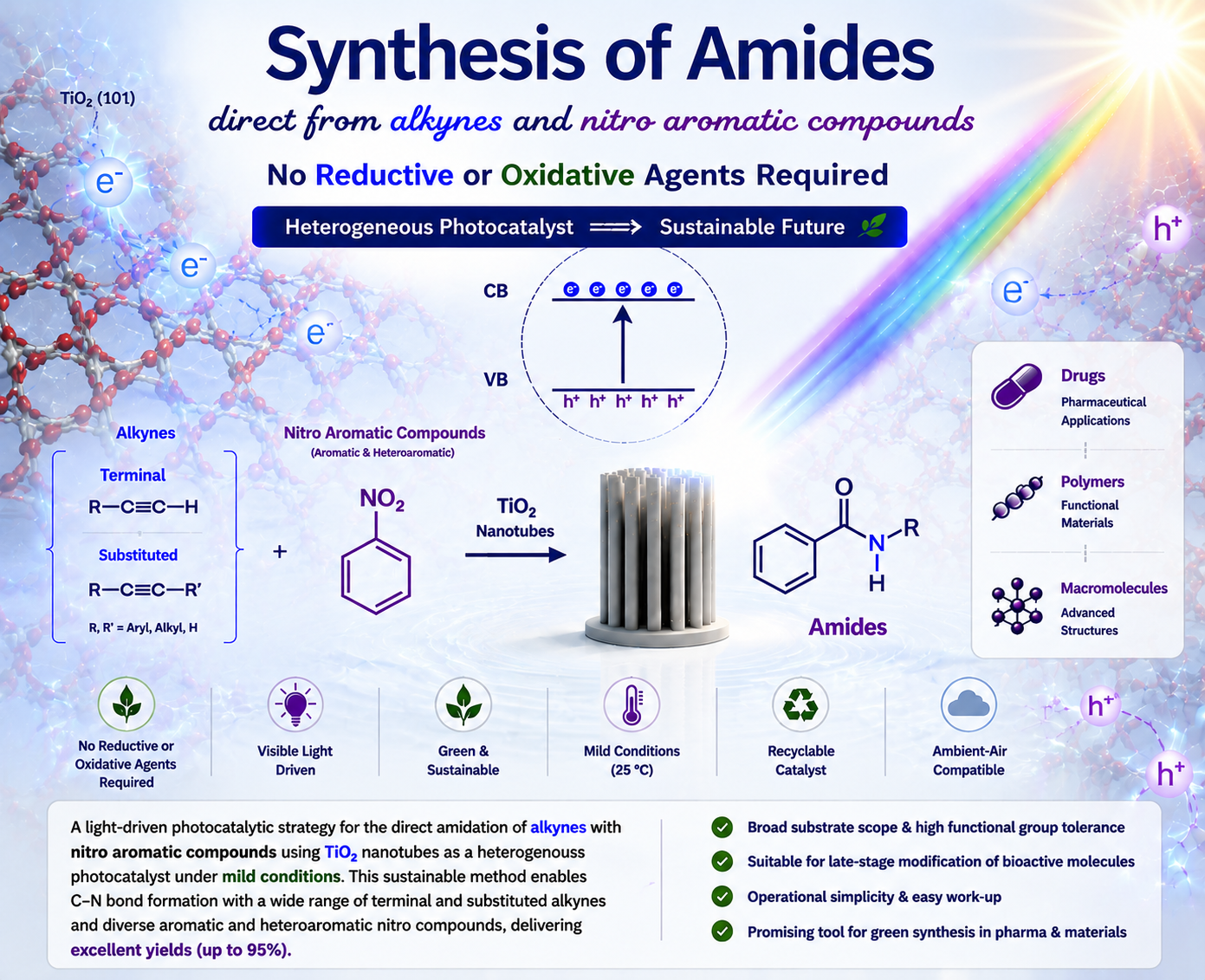
Amides are one of the most fundamental functional groups in organic chemistry, playing a central role in pharmaceuticals, agrochemicals, and advanced functional materials. Despite their widespread importance, traditional amide synthesis typically relies on condensation reactions that generate stoichiometric waste and often require activating agents, making them environmentally unsustainable and less atom-economical. In recent years, direct amidation strategies have attracted significant attention as a more sustainable alternative. However, most reported methods still rely on toxic reagents, harsh reaction conditions, or precious-metal catalysts, thereby limiting their practical and environmental advantages.
In this work, we present a novel light-driven photocatalytic platform for amide bond formation through the previously underexplored coupling of alkynes and nitroarenes. This transformation is enabled under mild conditions (ambient temperature, 25 °C) using heterogeneous TiO₂ nanotubes as an efficient and recyclable photocatalyst under visible-light irradiation.
Remarkably, this method delivers high efficiency and excellent yields (up to 95%), while tolerating a broad scope of both terminal and substituted alkynes, as well as structurally diverse aromatic and heteroaromatic nitro compounds. The reaction demonstrates excellent functional group compatibility, making it highly suitable for the synthesis of structurally complex and pharmaceutically relevant amides.
Beyond simple bond formation, this strategy also enables late-stage functionalization of bioactive molecules, highlighting its potential utility in drug discovery and fine chemical synthesis. Mechanistic investigations suggest a tentative catalytic pathway involving photoexcited TiO₂ surfaces and controlled radical or electron-transfer processes.
Overall, the combination of operational simplicity, ambient-air compatibility, visible-light activation, and catalyst recyclability makes this approach a powerful and sustainable alternative for modern amide synthesis. This work advances green chemistry by providing a practical, scalable route to valuable amide-containing compounds for pharmaceutical and materials science applications.
文章链接: